By Industry – Banking

API and AI Solutions for Banking

The banking industry is undergoing intense digital transformation as customers, fintech partners, and regulators demand more open, secure, and real-time access to financial services. Traditional banking architectures—built on monolithic cores, tightly coupled integrations, and siloed channels—struggle to meet the expectations of modern consumers and the competitive pressures of agile fintech firms. At the same time, regulatory frameworks such as PSD2, Open Banking, ISO 20022, and various national data-sharing mandates require banks to expose standardized APIs to authorized third parties while maintaining strict security and auditability. These forces have created an urgent need for a controlled, scalable, and secure way for banks to expose and manage APIs.

Flexible and SECURE
Secure Modern Innovation

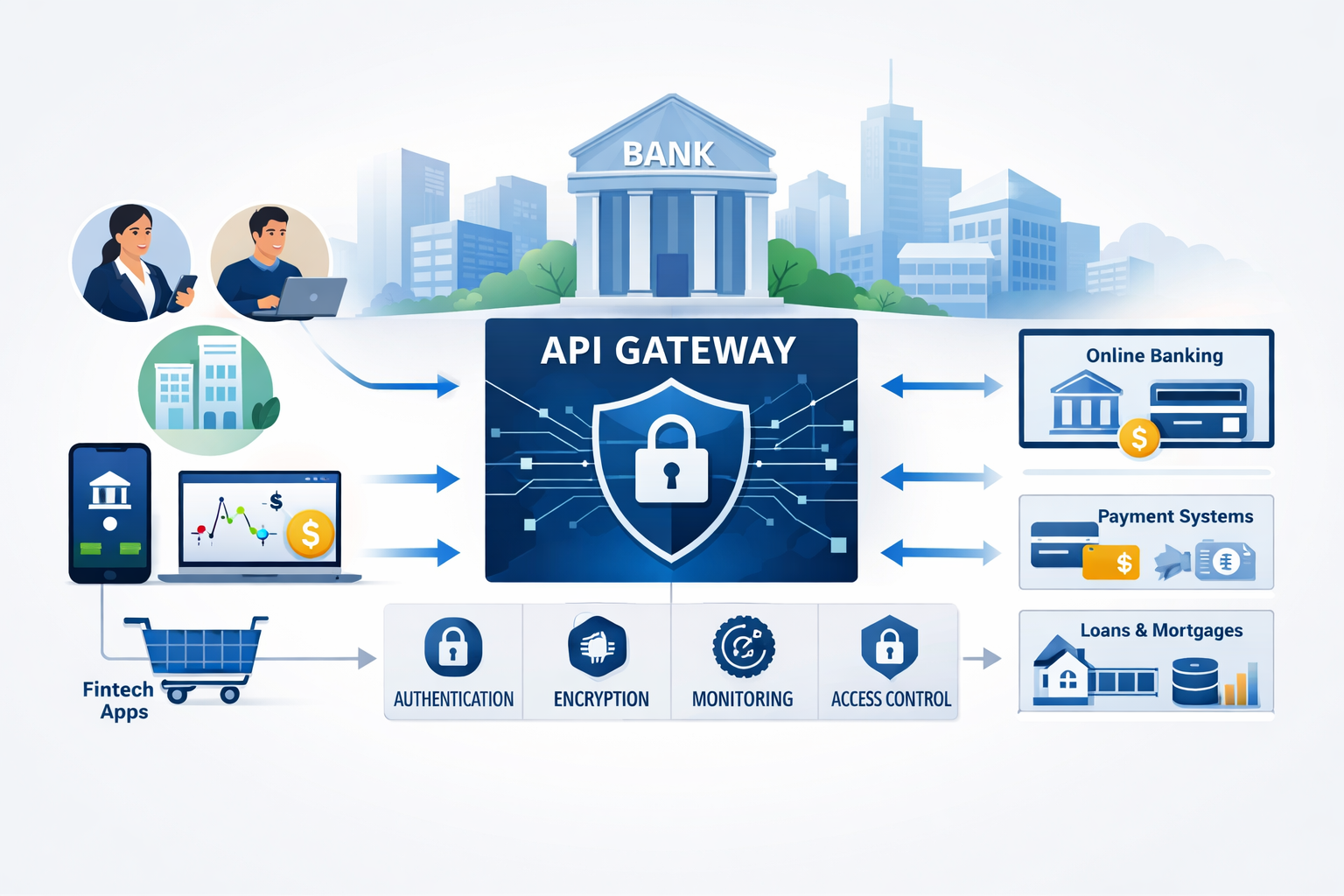
An API Gateway serves as the digital front door for financial institutions, enabling them to centralize authentication, authorization, throttling, routing, observability, and threat detection across all internal and external API traffic. By placing a Gateway between legacy systems and modern digital channels, banks are able to abstract complexity, enforce consistent governance, and accelerate delivery of new products and services. This becomes particularly powerful in multi-channel environments where mobile apps, internet banking portals, call centers, branches, ATMs, open banking partners, and internal development teams all consume the same underlying services. Instead of maintaining redundant integrations and inconsistent security models, the bank adopts a unified platform that improves reliability, compliance, and operational efficiency.


proven roi

Cost Reduction and Risk Mitigation

From a business perspective, an API Gateway directly contributes to cost reduction, risk mitigation, and revenue generation. Integration costs drop dramatically because teams can reuse standardized APIs instead of building point-to-point connections. Compliance teams benefit from central logs, analytics, and security enforcement, reducing audit effort and exposure to penalties. Innovation cycles speed up, enabling banks to launch new capabilities—such as instant payments, embedded finance offerings, digital onboarding, and AI-driven personalization—much faster than before. Moreover, API monetization becomes a viable revenue stream as banks can securely expose premium data and payment services to partners, corporate clients, and fintech ecosystems.

strategic enablement

Speed, Security, and Interoperability

An API Gateway is not merely a technical component; it is a strategic enabler for modern banking. It provides the foundation required to deliver scalable digital services, meet regulatory requirements, reduce operational complexity, strengthen security posture, and unlock new commercial opportunities. Banks that implement a robust API Gateway position themselves to compete effectively in a rapidly evolving financial landscape where speed, security, and interoperability define market leadership.

Industry Leading API Security Innovation

Transport Security

Protocol break Built-in PKI engine FIPS 140-2 TLS 1.2 ciphers Protocol translation

Message Security

Bi-directional transaction correlation Full payload contextual analysis

Threat Mitigation

AV and malware scanning OWASP top 10 protection RegEx pattern engine Rate and size SLA control

Data Integrity

Request and response schema validation DSIG and DSIG Verification

Data Privacy Assurance

Encryption and Decryption Data encoding or redaction

Authentication and SSO

Conversion of any-to-any PKI Auth, HTTP Auth, SAML, OAuth, OpenID Custom identity token

Data Translation

Header and Body mapping Conversion of XML, JSON Transformation

Auditing

Machine Learning META Data Format AI Logs Full context transaction logging