By Industry – Energy

API and AI Solutions for Energy

The energy sector is undergoing one of the most significant transformations in its history, driven by the global shift toward decarbonization, grid modernization, distributed energy resources (DERs), and digital customer engagement. Utilities and energy companies must now unify and integrate a diverse ecosystem of operational technology (OT), information technology (IT), and emerging digital platforms. Legacy SCADA systems, AMI/AMR meters, GIS platforms, customer information systems (CIS), outage management systems (OMS), billing platforms, IoT sensors, renewable energy assets, and market trading platforms frequently operate in silos with incompatible protocols. As regulatory bodies push for increased interoperability, transparency, and modernization—such as FERC, NERC, ISO/RTO requirements, and European energy directives—energy companies must adopt a scalable, secure, and standardized integration framework.

Flexible and SECURE
Secure Modern Innovation

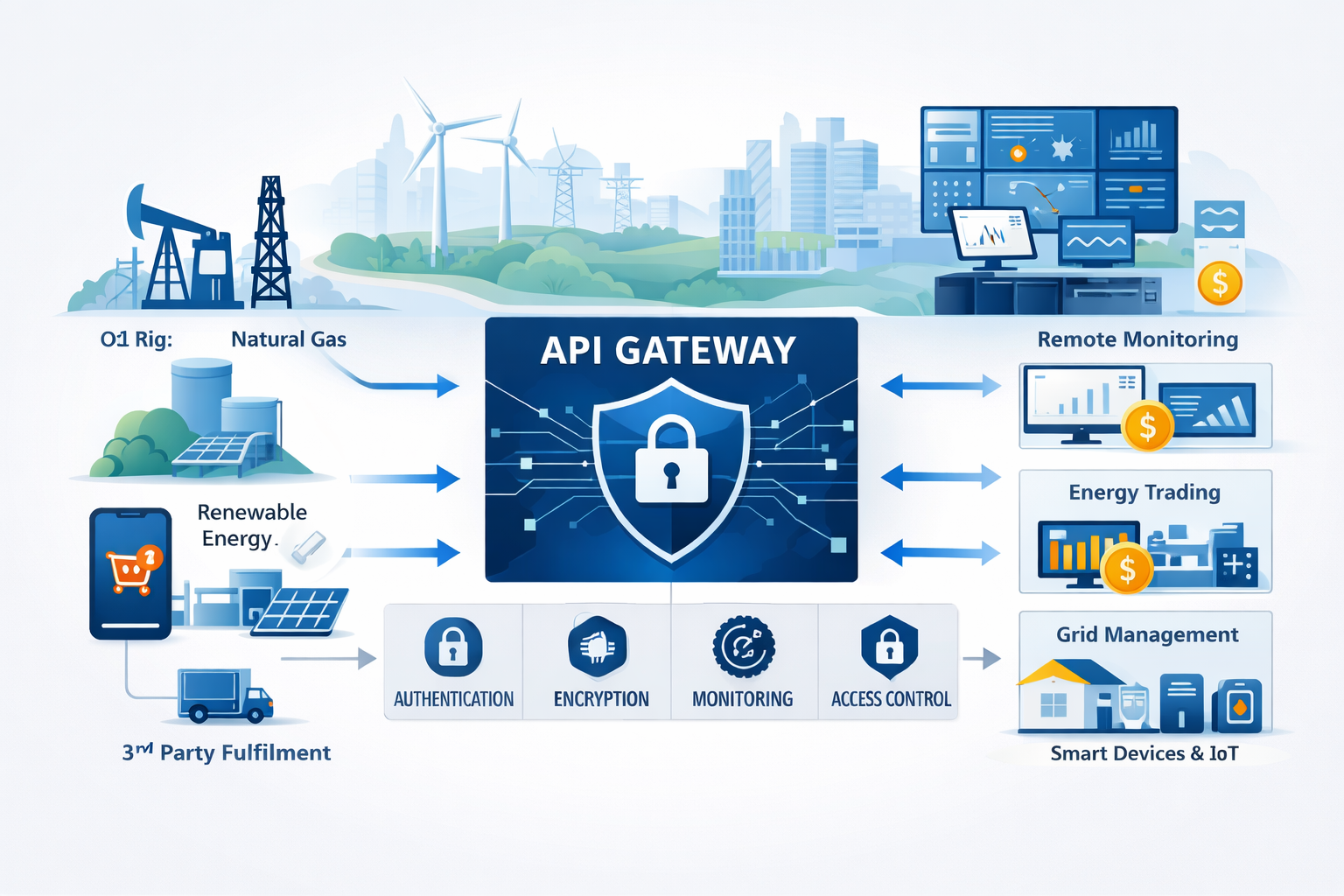
An API Gateway plays a critical role in enabling this digital transformation by serving as a centralized, secure, high-performance orchestration layer for all enterprise APIs. Operating as the authoritative entry point for machine-to-machine communication, mobile applications, field-service tools, and partner systems, the Gateway provides robust authentication, authorization, rate limiting, traffic shaping, and anomaly detection. This ensures consistent governance across both traditional IT systems and modern digital services, while helping organizations integrate legacy energy systems with cloud platforms, data analytics engines, DERMS, customer engagement portals, EV charging networks, and energy marketplace partners. The API Gateway accelerates innovation by decoupling front-end services from core operational systems—empowering teams to deliver new digital capabilities such as predictive maintenance, self-service outage reporting, real-time energy usage dashboards, and dynamic pricing services.


proven roi

Cost Reduction and Risk Mitigation

From a business and operational perspective, an API Gateway drives measurable improvements in resilience, compliance, operational efficiency, and customer satisfaction. Energy providers gain enhanced system reliability through consistent traffic management and caching, reducing load on legacy systems during peak demand events. Centralized governance reduces cyber-risk—critical in a sector increasingly targeted by ransomware and nation-state threats—by enforcing uniform security policies across IT and OT environments. Additionally, the Gateway standardizes data exchange between internal systems and external stakeholders, enabling faster integration with renewable energy partners, wholesale market operators, EV charging networks, and smart-home platforms. This agility allows energy companies to develop new services, unlock data-driven insights, and optimize asset performance through advanced analytics and digital twins.

strategic enablement

Speed, Security, and Interoperability

An API Gateway is a strategic enabler for the future of energy operations, providing the foundation for modernization, regulatory compliance, and digital innovation. It ensures secure data exchange across complex energy ecosystems, enhances operational visibility, supports grid modernization initiatives, and creates new revenue opportunities through partner APIs and digital services. Energy companies that embrace an API Gateway position themselves to lead in a landscape defined by distributed energy resources, customer-centric digital experiences, and rapidly evolving energy regulatory frameworks.

Industry Leading API Security Innovation

Transport Security

Protocol break Built-in PKI engine FIPS 140-2 TLS 1.2 ciphers Protocol translation

Message Security

Bi-directional transaction correlation Full payload contextual analysis

Threat Mitigation

AV and malware scanning OWASP top 10 protection RegEx pattern engine Rate and size SLA control

Data Integrity

Request and response schema validation DSIG and DSIG Verification

Data Privacy Assurance

Encryption and Decryption Data encoding or redaction

Authentication and SSO

Conversion of any-to-any PKI Auth, HTTP Auth, SAML, OAuth, OpenID Custom identity token

Data Translation

Header and Body mapping Conversion of XML, JSON Transformation

Auditing

Machine Learning META Data Format AI Logs Full context transaction logging