By Industry – Financial Services

API and AI Solutions for Financial Services

The financial services industry is undergoing rapid digital evolution driven by shifting customer expectations, growth of fintech competition, increased regulatory scrutiny, and the accelerating demand for personalized, real-time financial products. Traditional financial institutions—including insurers, brokerages, investment firms, and payment providers—are increasingly reliant on a complex network of internal systems and external partners: CRM platforms, underwriting engines, actuarial models, trading systems, risk analytics, policy administration systems, KYC/AML services, payment rails, and third-party data providers. These systems frequently operate in isolated technology stacks, making integration slow, costly, and difficult to scale. As organizations modernize toward cloud-native architectures and data-driven operating models, the need for a secure, standardized, and high-performance integration layer has become mission-critical.

Flexible and SECURE
Secure Modern Innovation

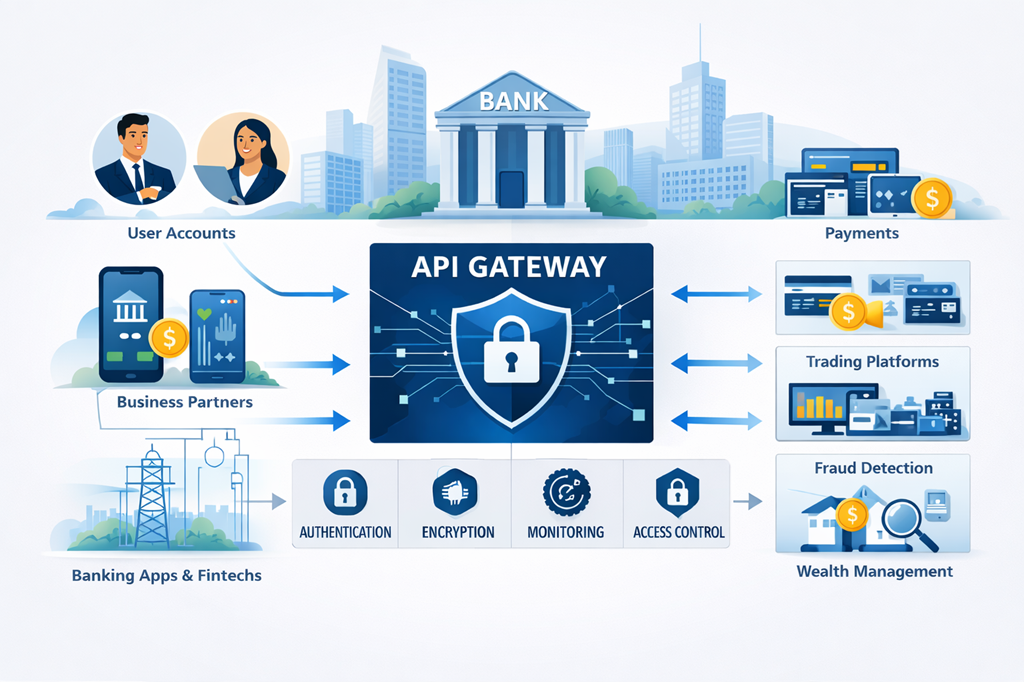
An API Gateway serves as the cornerstone of digital transformation in financial services by providing a centralized entry point for secure data exchange and service orchestration. It enforces consistent authentication, authorization, rate limiting, traffic routing, and threat protection across customer-facing and internal APIs. This enables institutions to safely expose financial data and services—whether to mobile apps, advisor portals, trading platforms, compliance tools, payment processors, fintech partners, or third-party marketplaces—while maintaining complete control and visibility over data flows. By decoupling front-end digital experiences from legacy core systems, the Gateway accelerates the deployment of new financial products such as instant payments, robo-advice, embedded insurance, real-time credit decisioning, ESG scoring engines, and hyper-personalized investment recommendations.


proven roi

Cost Reduction and Risk Mitigation

From a business value perspective, an API Gateway delivers meaningful improvements in operational efficiency, customer engagement, and risk management. Centralized governance and uniform security policies help institutions comply with regulatory requirements such as SEC, FINRA, MiFID II, GDPR, NAIC, AML/KYC mandates, and emerging open finance frameworks. Performance improvements—through intelligent caching and optimized routing—reduce latency across trading workflows, portfolio analytics queries, and payment operations, directly impacting client satisfaction and execution efficiency. Institutions also benefit from accelerated integration with custodians, brokers, reinsurers, payment processors, credit bureaus, and fintech platforms, enabling rapid innovation while reducing reliance on brittle point-to-point connections. The result is a more agile, data-driven organization capable of scaling services quickly and securely.

strategic enablement

Speed, Security, and Interoperability

An API Gateway is a strategic enabler of competitive advantage in financial services. It strengthens cybersecurity posture, simplifies compliance, enhances operational resilience, and provides a flexible foundation for digital product innovation. Organizations that deploy a robust API Gateway are better positioned to offer seamless omnichannel experiences, monetize premium data services, expand into embedded finance ecosystems, and meet the rising expectations of clients, regulators, and distribution partners in a highly competitive financial landscape.

Industry Leading API Security Innovation

Transport Security

Protocol break Built-in PKI engine FIPS 140-2 TLS 1.2 ciphers Protocol translation

Message Security

Bi-directional transaction correlation Full payload contextual analysis

Threat Mitigation

AV and malware scanning OWASP top 10 protection RegEx pattern engine Rate and size SLA control

Data Integrity

Request and response schema validation DSIG and DSIG Verification

Data Privacy Assurance

Encryption and Decryption Data encoding or redaction

Authentication and SSO

Conversion of any-to-any PKI Auth, HTTP Auth, SAML, OAuth, OpenID Custom identity token

Data Translation

Header and Body mapping Conversion of XML, JSON Transformation

Auditing

Machine Learning META Data Format AI Logs Full context transaction logging